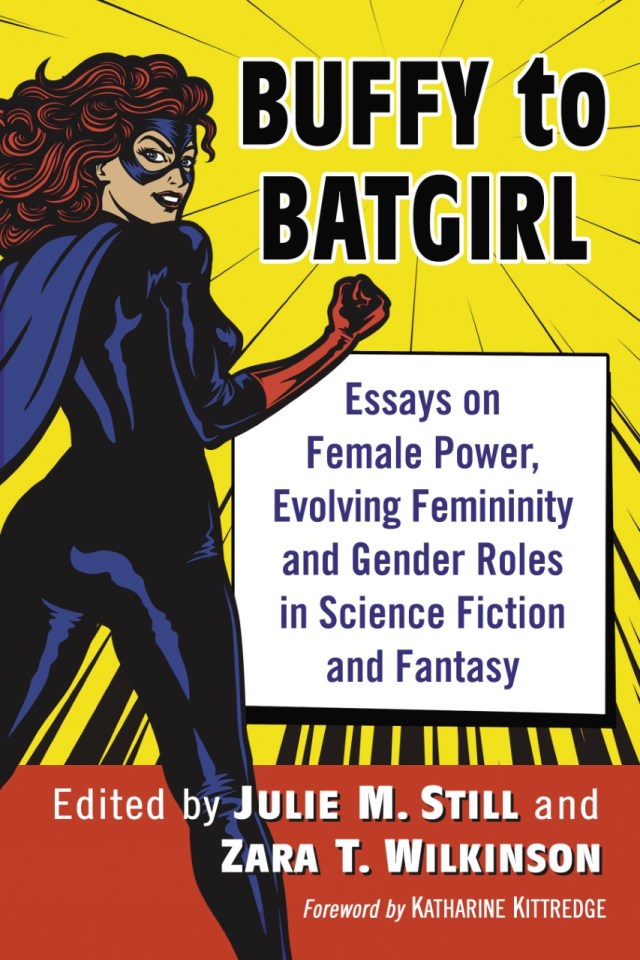
It’s out! It’s out! The proceedings volume for the 2014 Buffy to Batgirl conference has been published by McFarland, co-edited by Zara Wilkinson and myself.
![]()
It’s out! It’s out! The proceedings volume for the 2014 Buffy to Batgirl conference has been published by McFarland, co-edited by Zara Wilkinson and myself.
![]()
The Economic and Business History Society met for its annual conference in Detroit, June 5th through 8th, 2019. As always, this was a fun conference. There were several people named Erik / Eric in attendance. At one session there was a discussion on what the group name for this gathering would be. It was decided that a group of Eriks with a K would be a raid of Eriks. Erics with a C are a castle of Erics. Now, honestly, what other conference does this sort of thing?
These are some of the panel sessions I attended:
Trade and Manufacturing in Colonial America
Sophie Jones started off the session with a talk on “An Absence of Manufacturing: The Curious Case of Colonial New York.” New York City imported a lot of its manufactured goods from the UK instead of developing manufacturing in the city. Later local manufacturing emphasized ties to the UK, and UK social norms set standards for dress and behavior. In lieu of manufacturing the city developed leisure activities, such a shopkeeping and gardening.
This set up the next talk, “Locally Global: Capital Investment and Merchants in Colonial Boston, New York, and Philadelphia,” by Jeremy Land, who also helped organize the conference. One of his points is that local investment provides capital investment. This led to rising purchasing power of British America. Merchants were also key sources of funding for public projects like roads and wharves.
For a change of pace Eric Oakley talked about “These Beautiful Isles: Small Islands as Commercial Outposts in the Age of Sail.” He focused on small islands, roughly the size of Hawaii or smaller. Some were navigational aids or seamarks, others were logistical points, providing fresh provisions, and some were “entrepots,” places of maintenance and other ways of enhancing the trade.
Appearances Matter: Popular Culture and Identity Economics
The first talk of this session, “Trrrappings of a Revolution: The Commercial Co-option of the Riot Grrl Punk Aesthetic,” by Anna Stoutenburg, focused on the riotgrrrl movement that started in the late 1980’s and spread through zines. As it got more press mainstream culture adopted some of the riot grrl aesthetic.
Mikko Juhani and Anna Sivula presented information on a collection of interviews with 121 shipbuilders in Rauma.
Deryuan Yang spoke about the Ghost Month in his presentation “The Impact of the Ghost Month: Evidence from Marriage and Birth Data.” There is some belief that the 7th lunar month is unlucky. There are fewer weddings that month.
New Methodologies in Colonial Atlantic History
I missed one of the papers in this session.
Christine Cook, with “Your Little Madam Snip,” focused on women in the Askin family and their impact on the family business. Male tailors made patterns and cut fabric pieces, female seamstresses sewed the pieces together. Buttons were removed to wash garments and then sewn back on.
In “What’s in a Name: Wealth and Slave Names in York County, Virginia Probate Records,” Wendy Lucas’s research was read by moderator Fred Gates. Lucas reviewed probate records to see which mentioned slaves by name. It was beneficial to list the names of slaves with specific skills (blacksmithing, etc) and was also a function of estate wealth.
Sports and Tourism
Diana Ahmad talked about “Hawaiian Culture: Little More Than a Crop to be Harvested.” The popularity of “Moby Dick” led to an increase in Hawaiian tourism and cargo ships had more room for tourists. There was a dramatic increase in tourism in the early 1900’s.
Michael Haupert in “There’s a Girl on the Field, but Who’s in the Stands?” focused on the women’s baseball league in the 1940’s and 1950’s. He talked about the popularity of baseball, as wholesome entertainment, and that people went to women’s baseball games for the same reason they went to men’s baseball games.
New Research Methodology in Economic History
The first of two papers on aviation history, Peter Meyer presented on “The Great Aviation Patent Spike of 1910.” He noted that the spike in patents came after public demonstrations of aircraft, and gave examples of varying terms used to describe different types of air vehicles. He also pointed out that there was an increase in bibliographies on aeronautics to provide information.
Erik Benson spoke on “Curbing the Enthusiasm: Recent Aviation History from an Economic Perspective.” I was a little too nervous to listen as well as I should have to this talk.
I spoke last, talking about the pitfalls of searching online newspapers. Some of my points were taking into account spelling variations, abbreviations, the change of word usage over time, and how the Tasini vs New York Times Supreme Court case affected information retrieval.
Global effort: Case Studies in Labor and Human Capital
This research focused on the labor force in Russian factories. Amanda Gregg presented “Modernization in Progress: Part-Year Operation, Capital Accumulation, and the Labor Force Composition in Late Imperial Russia.” She looked at 1894 industrial data. Factories that operated part of the year were more rural and in more agricultural areas, especially wheat. Factories that operated all year were more likely to survive.
Olli Turunen spoke on “Creating a Multilingual Corpus of Nineteenth Century Economics to Research Conceptual Development.” He would like to create a database of nineteenth century economic literature in French, German, and English, in a consistent accessible format.
Robert Kaminski’s talk was entitled “Harvesting Horizontal Integration: Labor Relations, Corporate Strategy and the Great Merger Movement, 1885-1902.” He examined strikes at McCormick in 1885 and how the company responded. There was a lockout and another strike in 1886.
As usual the conference offered a group field trip one afternoon. This year we went to the Henry Ford Museum and Greenfield Village. The Village was comprised of historic buildings that were moved or recreated to this site. I went to the Wright Brothers bicycle shop, the childhood home of George Washington Carver, and William Holmes McGuffey (of McGuffey Reader fame). The village is also a working farm with horses, sheep, and at least one resident cat. The Ford Museum had several interesting exhibits, including one on Star Trek.
The keynote speaker at the annual dinner was John Naglick, Chief Deputy CFO / Finance Director for the city of Detroit. He talked about the process the city went through to get back on track financially. It was illuminating and interesting, and at times alarming. It is the sort of presentation people are unlikely to hear anywhere else.
Next year EBHS will meet in Atlanta.
You meet the most interesting people at CCAHA conservation workshops! I was at a workshop on preserving photographic scrapbooks and met Irina Glick, who has a website in Russian. She has been interviewing Special Collections librarians, posting the interviews in Russian, and then later posting English translations. You can take a look at the Russian version here.
Conference Report: Currents of American Culture and Its Study (Eastern American Studies Association), March 29-30, 2019, Harrisburg, PA
Like most small regional conferences this one is welcoming to all comers and a place to present and hear people present on early stage research.
I missed the first Friday afternoon sessions but did attend the last panel of the day. Mary Kate Cowper talked about waves of Puerto Rican identity. I was very intrigued by her mention of the Borinquena graphic novel (https://www.la-borinquena.com/). The second speaker on the panel, Kathryn Holmes, talked about plastic surgery in Utah, focusing on Mormons. “Mommy makeovers,” designed to counter the effects of childbirth. The third speaker on the panel was Aaron Rovan, whose topic was street children in 19th century America. One item he pointed out was that street children were sometimes called “street Arabs,” thought most were Irish and German, most especially in the period just after the Civil War. The final speaker was David Giles who focused on misogyny and the Internet. I was also able to enjoy the banquet on Friday evening, preceded by the keynote address, The Democracy of Ice Cream, by John Kasson of the University of North Carolina at Chapel Hill. The dinner conversation was just as interesting, and the food was very good as well.
The Saturday sessions were equally interesting. For the first morning session I heard John Price talk about Star Trek Axanar, Camille Sleight-Price on #Blackhogwarts, Brittany Clark on how retails workers are gendered on film, and Jose Feliciano on “relevance and Community when Museums are Not Neutral.” Price’s talk focused on the hierarchy of authenticity and fan created materials. Sleight-Price spoke about the twitter hashtag #blackhogwarts, which involved reimagining the characters in Harry Potter as Black. Clark looked at the presentation of retail workers in film over time; in earlier films retail work was a sign of being poor, but in later films it was a sign of stunted maturity. Feliciano pointed out that many cultural institutions are not neutral and were based on legacies of colonialism.
I was part of a panel on Saturday. My topic was my bike routes project. Also on the panel were McKenna Britton who spoke at the Women at Work on Cooper Street project, tracking the women who lived on Cooper Street in Camden, NJ and their employment. Bart Everts spoke about Peirce College’s transformation after World War I. Spero Lappis talked about a heartbreaking court case, Prig v Penn, which involved a woman who thought she had been freed from slavery but years later she and her children were taken back and sold.
There was a third session on Saturday but I had to leave before those talks. It was a really enjoyable conference experience and I hope to attend again in the future.
This blog post serves as a guide to information mentioned at the 2018 Mid-Atlantic Popular Culture Association conference in Baltimore. My presentation is “Trips Awheel: A Nineteenth Century Bicycle Travel Blog.”
Here are some useful links:
Bicycle Routes Project (https://libguides.rutgers.edu/historicalbikeroutes)
Bicycle Craze of the 1890’s
Hidden Cities Philadelphia article on the bike routes: https://hiddencityphila.org/2018/07/victorian-era-philly-bicycle-routes-now-available-online/
This is a brief research note on the history of the railroad, not of the mechanical aspects of it (for that see the wonderful Library of Congress page), but more of a cultural viewpoint, specifically literary. References to works aren’t in any citation format, but there is enough information to track it down. I pulled this together out of general curiosity but do not intend to pursue it further, hopefully someone else will.
Searching the American Periodical Series database for the word railroad I found some interesting things. The word’s earliest uses are hyphenated rail-road. A short article in The Emporium of Arts & Sciences on Nov. 1, 1812 explains how rail-roads worked. They were originally wagons hooked together to bring coal out of the mines in Newcastle, England. Some machinery was involved but horses still pulled the wagons. The wagon wheels were on rails made of wood, sometimes metal. There were a handful of articles discussing the relative merits of rail-roads over canals for transporting goods.
The concept of mechanized railroads seems to have been first mentioned in “Rail Roads and Locomotive Steam Engines,” in American Mechanics’ Magazine (June 4, 1825) and it was conceptual not describing something in use. The idea of using such a thing in Pennsylvania was discussed in “Internal Improvement: To the Pennsylvania Society for the Promotion of Internal Improvement in the Commonwealth,” in The New Jersey and Pennsylvania Agricultural Monthly Intelligencer and Farmer’s Magazine (Jan 1, 1826), possibly reprinted from the United States Gazette. In that same year there were a couple of articles on Long’s locomotive engine. In 1827 articles discussed the proposed Baltimore and Ohio railroad (still hyphenated) but part of that discussion was on whether it should be horse drawn or pulled by mechanical engines. At this point some articles started to exclude the hyphen and just use railroad. In 1829 there was a contest in England for an engine that could pull the most weight the fastest for the least money (“Grand Mechanical Competition: Rail-Road Race for 500,” Albion, a Journal of News, Politics and Literature, Nov 21, 1829). The Jan 16, 1830 Saturday Evening Post ran a letter someone wrote to his grandmother, recalling her story of travelling from Edinburgh to London in 10 days, to tell of a steam rail trip from Liverpool to Manchester in an hour (“Railroad Travelling in 1830,”). That same year James Linnard and others wrote a resolution published in the Register of Pennsylvania to build a railroad in Philadelphia, with details on the streets it should run on and across (“Pennsylvania Rail Road, Feb 6, 1830). Several other localities followed suit and other railroads were proposed.
I limited the search to fiction and found some early essays. One of the earliest references to the railroad that I can find in a short story is “Emily; Or, the Unexpected Meeting,” in New Monthly Magazine and Humorist (Oct 1839). Even then the railroad appears to be just a manner of conveyance and not a focus of the story. Miles Ryder’s story, “A Railway Trip,” in Fraser’s Magazine for Town and County (August 1840) is an early travel story.
The MLA International Bibliography database shows that little scholarship has been done on railroads on fiction. There were a handful of articles on Theodore Drieser’s Sister Carrie, and the novels of Willa Cather. There were a few dissertations listed, but they had a specific focus (geographic identity or British novels). There was an article on the American railroad novel in the Markham Review in the 1970s. I don’t see anything specifically on short fiction. Surprisingly there are articles on train stations in fiction, and one (“Shattered Minds: Madmen on the Railways, 1860-1880” by Amy Milne-Smith in the Journal of Victorian Culture in 2016) on mental illness brought on by use of railroads.
So there is a lot of fertile ground for scholarship on the railroads in American fiction. Grant Burns published The Railroad in American Fiction: an Annotated Bibliography in 2005 that would no doubt be a big help in locating primary sources.
Presentations are often the most important part of an interview (no pressure!). You want to have simple pleasing informative graphics. Nothing too fancy, just a simple PowerPoint is fine. If you have notes keep them out of sight. As far as possible, give the appearance of being relaxed. I know all that is a tall order. You will be forgiven a few mistakes more than you will a wooden presentation style. Everyone makes mistakes — it’s how you recover from them that counts. They are looking at this as an example you would talk to a classroom full of students so pretend you are talking to a group of 18 year olds. You know more than they do and what you are telling them will be useful to them. Your topic will probably have something to do with the position you are applying for so assume you are talking to a friendly group who are interested in what you are saying and that know far less than you do.
When I was a new librarian and giving presentations I would tell myself that 5 minutes after it was over no one would remember who I was. It helped me relax. It’s not a good tactic for everyone but it worked for me. Whatever mental trick you need to play on yourself to appear more relaxed, comfortable, and confident, do that.
Of course it is important to have actual information in your presentation but it isn’t a term paper. You don’t need to know everything, just enough to give a brief presentation about it.
Have a few extra points tucked away that aren’t on your presentation. Then if there are equipment problems you can cover by saying “while we’re waiting for the technical fix, let me elaborate briefly on an earlier point.” If someone asks you a question about a source you aren’t familiar with say something like “It’s been awhile since I read that — thank you for the reminder to review it again” or “I’m not familiar with that — thank you for the recommendation. I will look into that.” If someone disagrees with you say “That’s an interesting viewpoint. I had not thought to look at it quite that way.” and than go on with what you had planned to say. If you go blank on a question say “Can I think about that and come back to it later?” and then go on to the next question or just be hones “I’m sorry, I’m drawing a blank at the moment, can we come back to that?” or just “I’m not sure. Can I get back to you on that later?” and then follow up after the interview.
For patter in case there is a delay or a lull in conversation mention an article you have read recently and what you liked about it, ask what others think about the idea. Or try to make small talk.
At interview lunches avoid all pasta with red sauce (unless you are wearing a red shirt) and salads (big lettuce leaves are hard to chew with people staring at you and you might get lettuce stuck in your teeth — no one will tell you about it). Go with something you can cut into bite sized pieces and chew quickly. No spaghetti with any kind of sauce because it is too messy but pasta in smaller forms that you can eat in small forkfulls or one at a time are okay. Avoid greasy finger foods as you might have to shake hands with people who arrive late or stop by the table.
Be familiar with the institution. Look up demographics on the library and the student body so you can ask about it (for example, I see that you have had more first generation students in the last few years, has that impacted how you provide library services? or I notice that your student body has increased / decreased recently, how has that affected the library?). Look up people’s names and know if they have published or presented and what on.
The interview is an opportunity for you to decide if you want to work there just as much as it is for them to decide if they want to offer you the job. Ask questions and watch how people interact with each other. That will give you a good idea of the organizational culture.
Be yourself — everyone brought in to interview is qualified on paper. The interview is to determine who people want to work with and who will best represent their library.
The Genius of Birds, by Jennifer Ackerman. NY: Penguin, 2016
How smart are birds? Are they bird-brains in the derogatory sense? Not all of them, according to Ackerman. She writes about New Caledonian crows that have been observed making and using tools, like hooks to get at food in places too deep or narrow for their beaks to reach. Very few species do that. It was not that long ago that a dividing line between humans and other animals was our ability to make tools. Now in addition to some other primates we must add the crows. They have also learned how to crack nuts open, or drop them in the street so cars will crush the shell allowing the birds to reach the nutmeat inside.
Male bowerbirds build such elaborate nests that they were sometimes thought to have been made and discarded by humans. Ravens gather around their own dead. The directional abilities of homing pigeons are well-known but Ackerman finds new things to say about this bird and other birds’ amazing ability to find their way around and what recent research has discovered.
The book also discusses evolution, genetics, and learning strategies. She finds that birds with the longest childhoods and those with more safe time to “play” show greater mental abilities. The research on how birds learn mating songs is fascinating. Her writing is engaging and provides a great deal of information without being too dense or obtuse. This is a wonderful book to read to learn more about our feathered friends and neighbors. It was a New York Times bestseller and one of the Wall Street Journal’s 10 best non-fiction books of 2016.
The Twitter Habits of Britain’s Feline Civil Servants
Julie Still / Rutgers Univ / still@rutgers.edu / http://www.juliemstill.com
This is the basic handout information I provided at the MAPACA conference in Nov. 2017, and a related talk at the Westhampton Public Library in June, 2018
Larry the Cat, who lives at #10 Downing Street, is such an important part of British culture that former Prime Minister David Cameron felt compelled to provide photographic proof to Parliament that he and Larry got along. Larry is frequently photographed, filmed, and “quoted” in the British press. The cat has a twitter feed with over 100,000 followers. His fellow government felines, Gladstone in the Treasury Office, Palmerston in the Foreign Office, and Evie in the Cabinet Office, also tweet. In contrast the American presidential pets, the British cats are considered civil servants and are “employed” as mousers. Their twitter feeds comment on political events and do not always agree with the official positions of their offices.
The Big Four (Westminster Cats)
cat / url (cat name, date started, twitter followers)
Larry https://twitter.com/number10cat (Larry, 2/11, 179,000+)
Palmerston https://twitter.com/DiploMog (Palmerston official, 2/16, 61,000+)
Palmerston https://twitter.com/PalmerstonFOCat (Palmerston, unofficial, 4/16 23,000+)
Gladstone https://twitter.com/TreasuryMog (Gladstone, 10/16, 24,000+)
Evie https://twitter.com/HMCabinetCat (Evie 7/16, 23,000+)
Evie and Ossie https://twitter.com/CabOfficeMogs (Evie and Ossie 12/16, 4,000+)
Other Political Animals
Nemo Macron (First Dog of France) https://twitter.com/macronnemo?lang=en
Embassy cat (Julian Assange) https://twitter.com/embassycat?lang=en
Marlon Bundo (Mike Pence’s rabbit) https://twitter.com/realmarlonbundo
Claudius Kitten (British ambassador to New England) https://twitter.com/Catsul_General
Diplomat Dog (Canadian) https://twitter.com/diplomat_dog?lang=en
Gracie Brown (US ambassador to New Zealand) https://twitter.com/diploDogGracie
Paddles (former first cat of New Zealand) https://twitter.com/firstcatofnz
Lawrence of Abdoun (UK embassy in Jordan https://twitter.com/LawrenceDipCat
Non-political cats
Scamperbeasts (John Scalzi’s cats) https://twitter.com/scampberbeasts
SreetCat Bob https://twitter.com/StreetCatBob
Grumpy Cat https://twitter.com/realgrumpycat
Sockamillion https://twitter.com/sockington
map of where the Westminster cats live: http://www.telegraph.co.uk/news/2017/01/03/downing-street-cats-essential-information-important-westminster/
history of govt cats: http://blog.nationalarchives.gov.uk/blog/bureau-cats-heart-government

MAPACA, Nov 8 – 11, 2017, Philadelphia
There are several regional popular culture associations, in addition to the American Popular Culture Association. The Mid-Atlantic Popular Culture Association (MAPACA) is one of them. These conferences are a laboratory for new ideas, and because they are multiple sessions going on at once, you can pick the topics of most interest. The sessions I attended (see below) were interesting. Among the things I learned:
Mexico held a Day of the Dead parade after one was portrayed in a 007 movie
African City is an internet video series, about five young woman who grew up in the US and went home to Ghana. It has been described as an African version of “Sex and the City,” and there are similarities but it is also a well-made program. The episodes are 15 minutes each.
LaBeouf, Ronkko & Turner are doing some innovative work in public art
Female crafters are Etsy are frequently presented as doing home based crafts as a part-time business / hobby
Sessions I attended:
Film / Literature and tourism
Day of the Dead and 007 in Mexico City / Julia Sloan
Fried Green Tomatoes and the Needs of Female Film-Induced Tourists (Maura Grady and Robert D. Robertson
Braveheart, Outlander, and Harry Potter: Popular Culture Tourism Drivers and the Marketing of Scotland’s Cultural Heritage ( Karalee Dawn MacKay).
Social Media, Labor and Consumption
Crafted identity, Creative Labor: Affect and representation in an Etsy economy / Kayla Keener
Dainty v Dominant: Advertising consumption and gender portrayal through Facebook / Trevor Russell Arnold
Social Interaction vs Institutional Interaction: Platform Performances and Gender Labor / Angela M Cirucci
Politics and Social Media
Twitter and the Political Celebrity: Cory Booker / Paul Ziek
Promoting Libyan Nationalism Concepts via Facebook: A Crucial Discourse Analysis / Safa M Elnaili
Twitter Habits of Britain’s Feline Civil Servants / Julie Still
Art Narrative and Social Media
Mapping the Digital Counterflow: Exploring the Production Distribution and Reception of an African City / Krys Osei
Memes IRL: How the Performance Art of LaBeouf, Ronkko & Turner Unleashed an Internet Subculture into the Real World / Katie Elson Anderson
Rethinking the Lizzie Bennet Diaries: the Literary Approach to New Media Storytelling / Catharine Godlewsky
The Ukulele, YouTube and the Experience of Art / Nova Seals
Tropes that Transfer: The Cultural Impact of SF / Fantasy
Slashing Spock: Passing, Pon Farr, and “This Simple Feeling” / Danielle Suzanne Girard
Transferring the Visual Style of Jessica Jones from the Graphic Novel to the Netflix series / Eva Maria Thury
Cowboys in Space / Nola Thacker